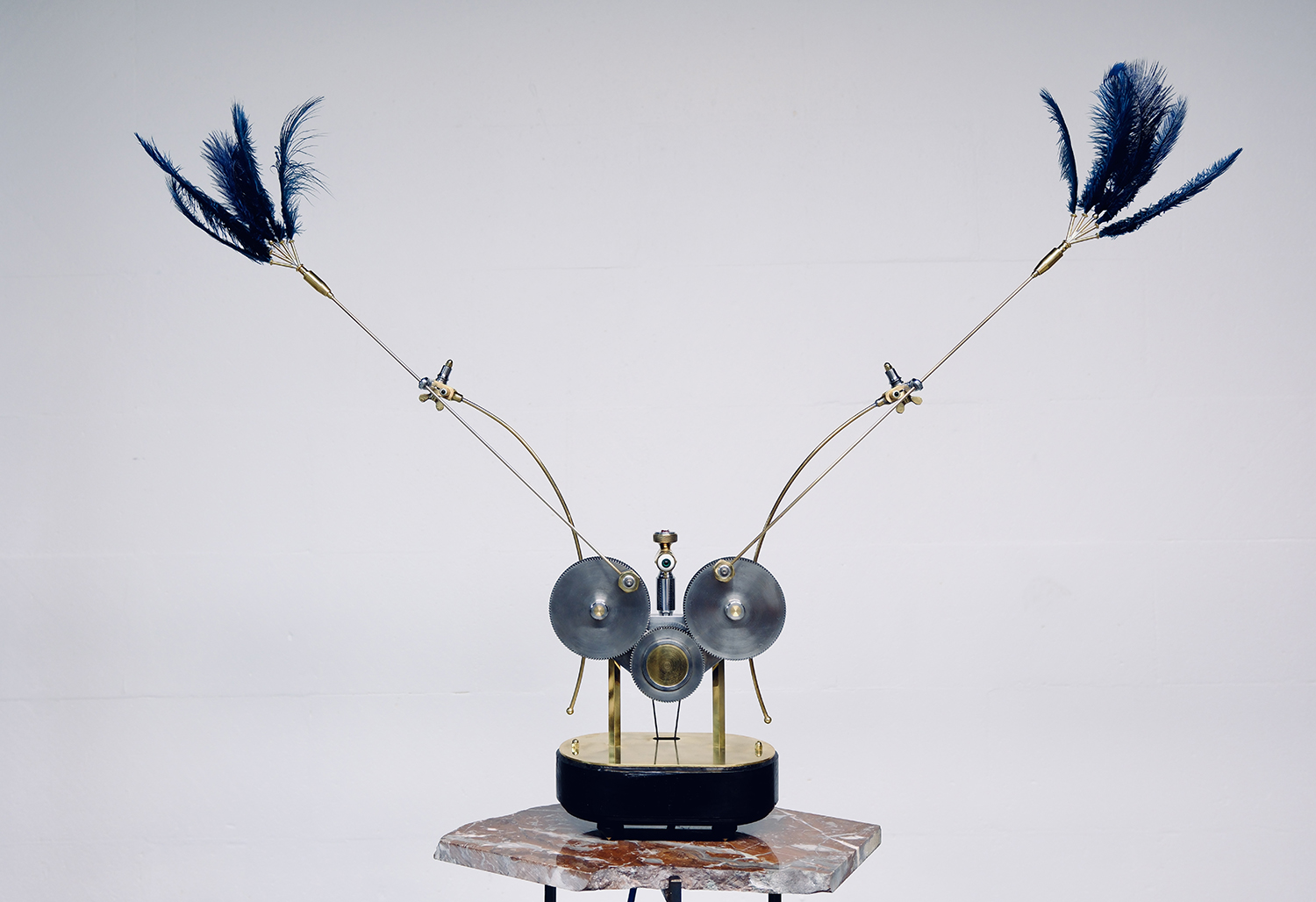
Mathieu Zurstrassen, 92Lb4, 2025
by Alexandra I. Mas
At CREA Cantieri del Contemporaneo, on the island of Giudecca, CYFEST 17 unfolds within a precise curatorial structure centered on Natura Naturans. The term, drawn from philosophical tradition, designates nature not as image but as generative force, an active condition in which form arises, transforms, and withdraws.
The exhibition, developed by CYLAND MediaArtLab in collaboration with Ca’ Foscari University of Venice and the CSAR – Center for Studies in Russian, Central Asian and Caucasian Art, situates itself within a lineage that extends from early twentieth-century abstraction to contemporary media-based practices.
This lineage is not presented as historical sequence but as continuity of method. The shift from representation to construction where color, light, and form detach from depiction and enter into autonomy, remains active. The works engage with systems rather than images, with processes rather than fixed objects.
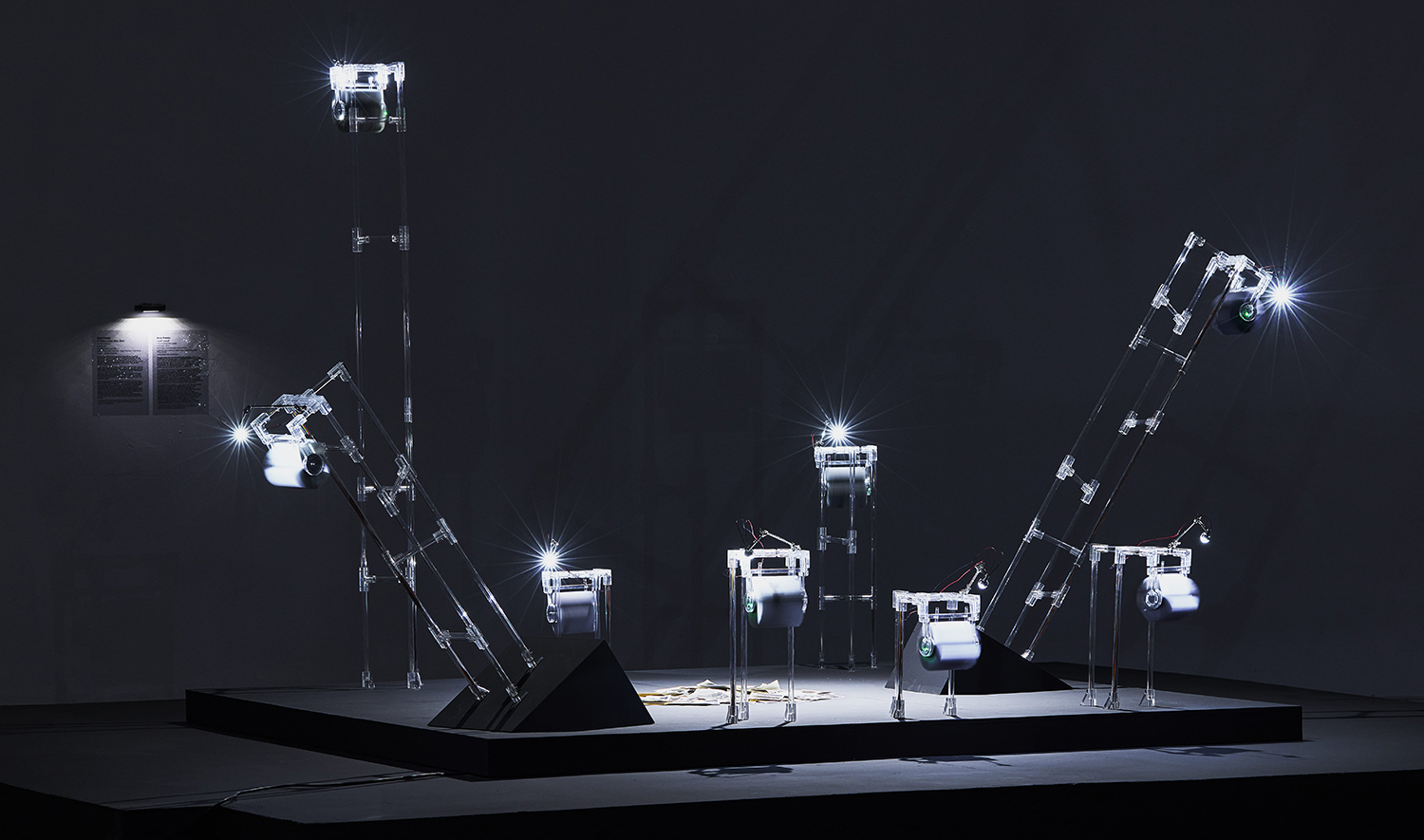
Anna Frants, To Make a Long Story Short, From Series Simple Joys, 2024, Installation. CYFEST 16, “HayArt” Centre, Yerevan, Armenia, 2024. Photo © Ann Prilutckaia
In the installations of Anna Frants, light is not deployed as illumination but as a measured phenomenon. It is produced, interrupted, and reconfigured through kinetic systems that operate with calibrated restraint. Mechanical elements—often discreet, almost withdrawn—activate sequences of appearance and withdrawal: appearance, delay, disappearance. Each cycle establishes a unit of time, not abstract but perceptible, anchored in the viewer’s presence.
The work unfolds through this repetition, we can talk about an interval.
Frants’ practice is grounded in a sustained engagement with technological systems—robotics, sensors, responsive structures, yet these tools are not foregrounded. They remain embedded within the work, functioning as conditions rather than subjects. The installations register input, movement, proximity and sound. Response is minimal, often delayed, producing a temporal disjunction between action and effect. This latency becomes central. It displaces immediacy and introduces a different rhythm of perception.
Her position within the field of media art is inseparable from this approach. Emerging from the experimental milieu of Leningrad now St. Petersburg, and extending into an international context, Frants maintains a continuity between early investigations into light and movement and contemporary computational processes. As co-founder of CYLAND MediaArtLab and the CYFEST platform, her work operates across both production and structure, artist and organizer, system builder and participant.
Within the exhibition, her installations establish a quiet framework. They define a space where technology withdraws into function, and where light, reduced to its essential condition, marks the passage of time with precision.
The kinetic sculpture by Mathieu Zurstrassen (on the cover ) articulates a system in which motion is neither expressive nor incidental, but constructed. Metal components rotate with calibrated precision, each element positioned within a closed circuit of tension and release. The structure holds itself through balance and nothing exceeds its function.
At its extremities, feathers extend the mechanism outward. Their presence introduces a register of lightness. Movement persists within a controlled rhythm, governed by mechanical continuity. Zurstrassen, trained as an architect, approaches form as a system to be built rather than represented. His works operate through assembly, mechanical motion, coded interaction, material adjustment, where each component participates in a larger operational logic. Objects are dismantled, reconfigured, and returned as structures that expose their own functioning.
His work maintains a direct relation between hand and mechanism where a measured tension persists between control and contingency, between the exactness of the system and the slight deviations that arise through motion.
Based in Brussels, he founded Raise Studio, a laboratory oriented toward fabrication and experimentation across art, engineering, and technology. His work circulates across European and international contexts, maintaining a consistent focus on the material and conceptual conditions through which machines act, persist, and remain visible.
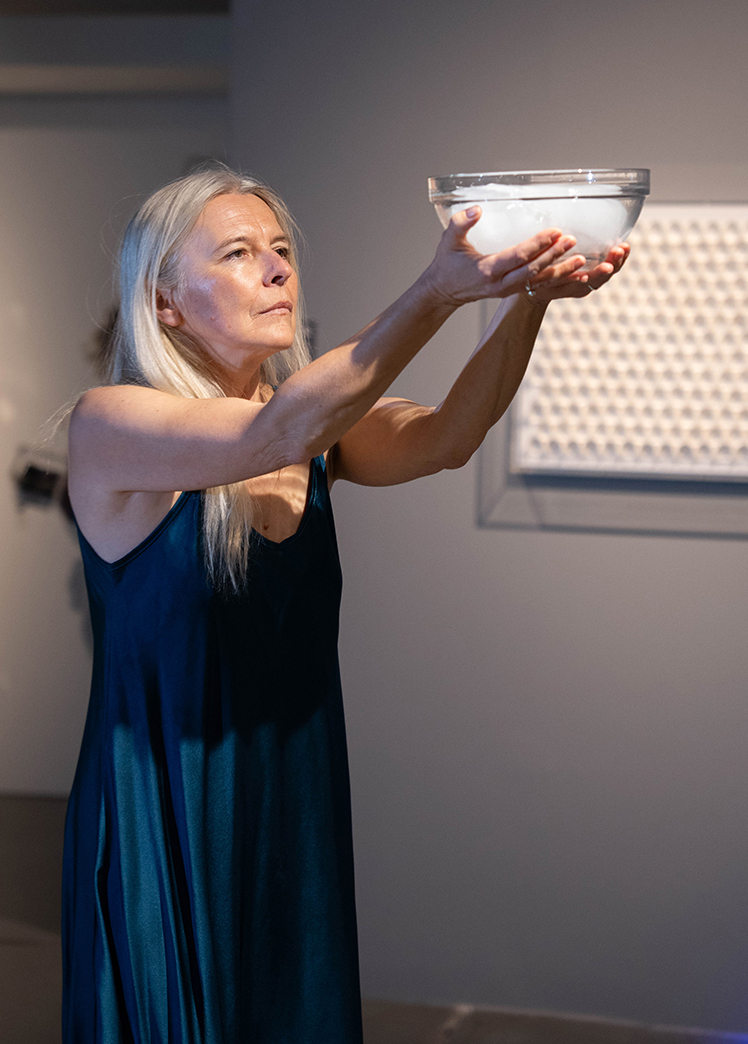
Jaanika Peerna, Warm Offering of Cold, performance, 2025
Jaanika Peerna’s performance Warm Offering of Cold engages the physical and perceptual conditions of glaciers, their slow movement, their instability, their persistence under pressure. The work registers an emotion rather than an image or even a scientific state.
It unfolds through a restrained field of gesture and trace. Lines extend across translucent surfaces, following the logic of natural forces: air currents, water flow, shifting ice.
Peerna’s broader practice sustains this approach. Gesture is not expressive but aligned with external conditions. The hand does not impose; it follows. Within this continuity, a tension persists between persistence and erosion, between what holds and what recedes.
Her performances remain anchored in this same economy. Movement is reduced. The body aligns itself with material conditions, allowing duration to define the work. Across installation and action, the focus remains on transformation as it occurs, without interruption, without emphasis. Rooted in northern landscapes and shaped by an attention to climate, her work maintains a direct relation to elemental forces. Ice is approached as substance. Its condition is neither altered nor accelerated. It unfolds within its own time.
On May 8, at CREA Cantieri del Contemporaneo, Jaanika Peerna activates a participatory gesture centered on a sculpted block of ice. The material is held, exposed, and allowed to transform. The audience enters this duration, witnessing a balance maintained between formation and dissolution.The opening extends with Hugo Solis’ live sound intervention structured through electronic modulation and spatial diffusion. In parallel,
Across the exhibition, natural phenomena, wind, light, temperature, movement, are engaged through constructed systems. These systems do not replicate nature; they operate within it, translating its dynamics into measurable processes. The presence of digital programming, kinetic structures, and algorithmic composition situates the works within a contemporary technological framework while maintaining continuity with earlier explorations of movement and perception.
The inclusion of works from the Frants Collection extends this framework across time, maintaining a focus on process-based thinking. Early avant-garde practices, postwar experimental approaches, and current media-based works share an attention to structure, to transformation, and to the conditions through which form becomes visible.
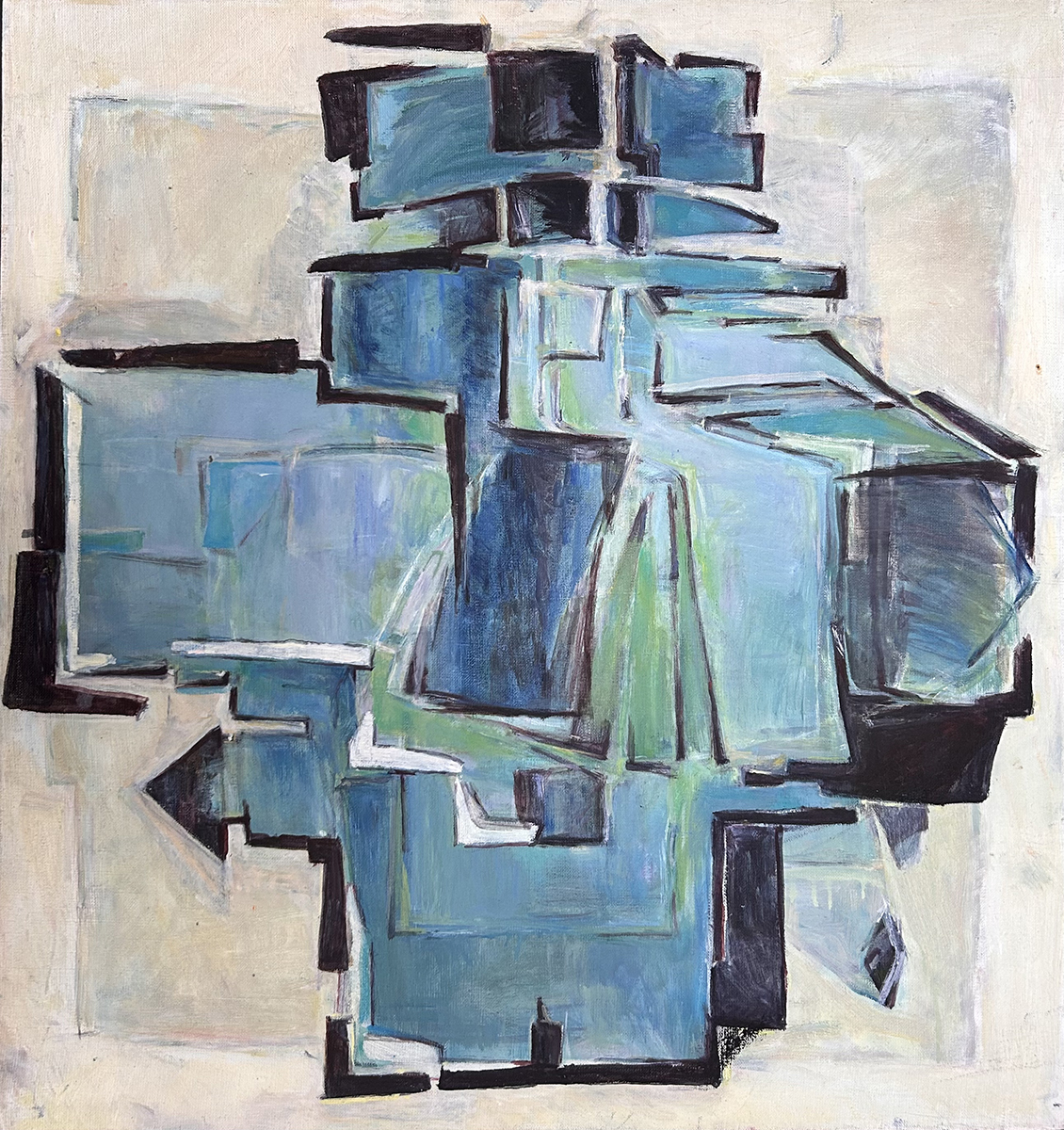
Valentina Povarova, From the series Crosses, 2000. Courtesy of the Frants Family Collection
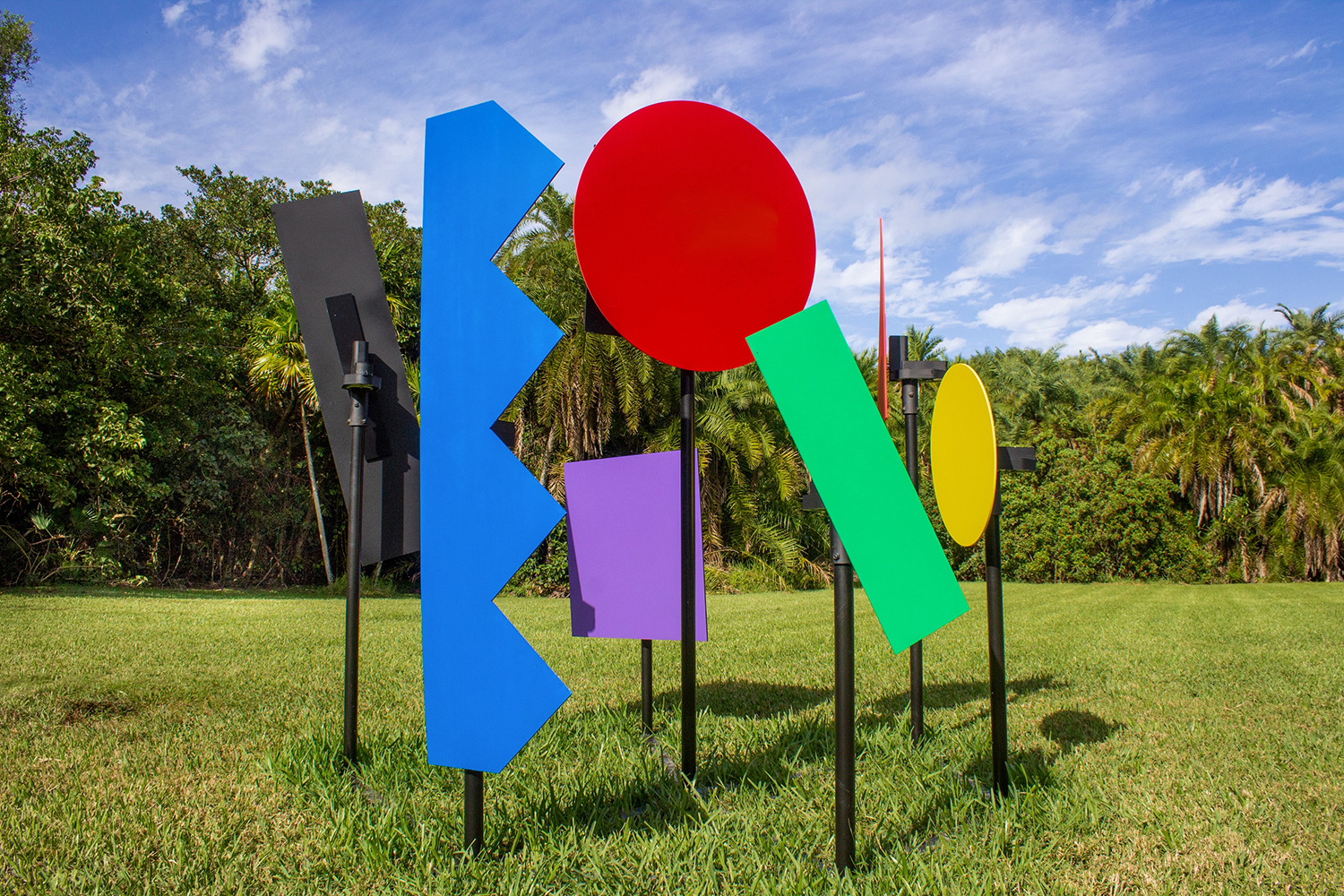
Elena Gubanova & Ivan Govorkov, Victory over the Sun, 2023. CYFEST-15 Vulnerability, Deering Estate, Miami, USA, 2023-2024. Photo ©Alexander Bochkov
The installation by Elena Gubanova and Ivan Govorkov reactivates the kinetic language of early avant-garde experiments. Movement is structured, extended, and translated into a contemporary technical vocabulary. Energy is not expressed; it is sustained through the system itself.
Within a different register, the collective AES+F constructs immersive visual environments where the body is rendered through digital synthesis. Their work navigates altered states of perception, where aesthetic refinement coexists with a latent unease. Figures appear suspended between narrative and abstraction, between presence and simulation.
The exhibition gathers a wide constellation of artists, forming a distributed field of practices: Andy Barrt; Aleksandr Bochkov & Matvei Peshkov; CAA (CYLAND Audio Archive); Alexandra Dementieva; Alexey Grachev; Sergey Kishchenko; Sergei Komarov & Lidiia Griaznova; Alexei Kostroma; Valery Koshlyakov; Natalia Lyakh; Linda Loh; Dmitriy Shishov; Eric Vernhes; and Mathieu Zurstrassen, among others.
The exhibition runs from May 8 to August 31, 2026, with performances, screenings, and discussions extending the project beyond the exhibition space.
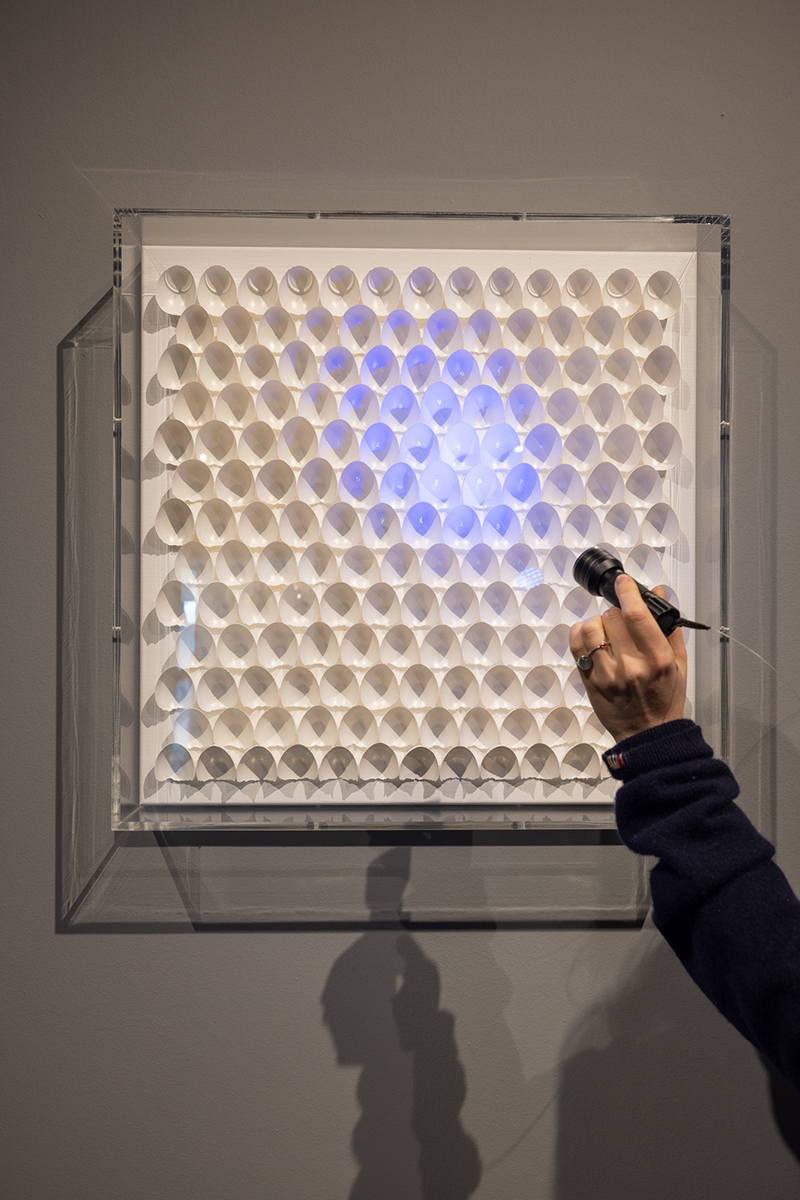
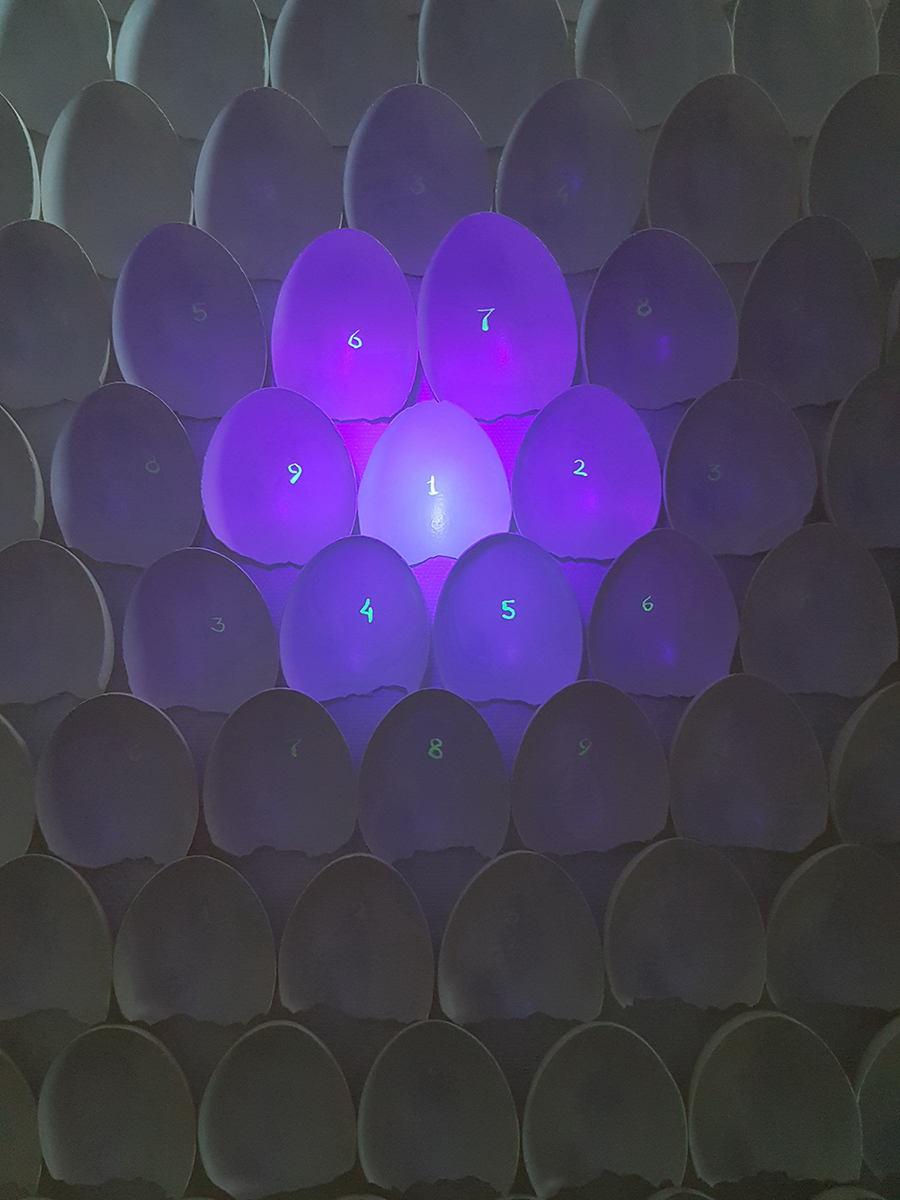
Alexei Kostroma, EGGSHELL. NANO 163, object, 2017, CYFEST 17, MOMus–Experimental Center for the Arts, Thessaloniki, Photo © Chloe Pissa