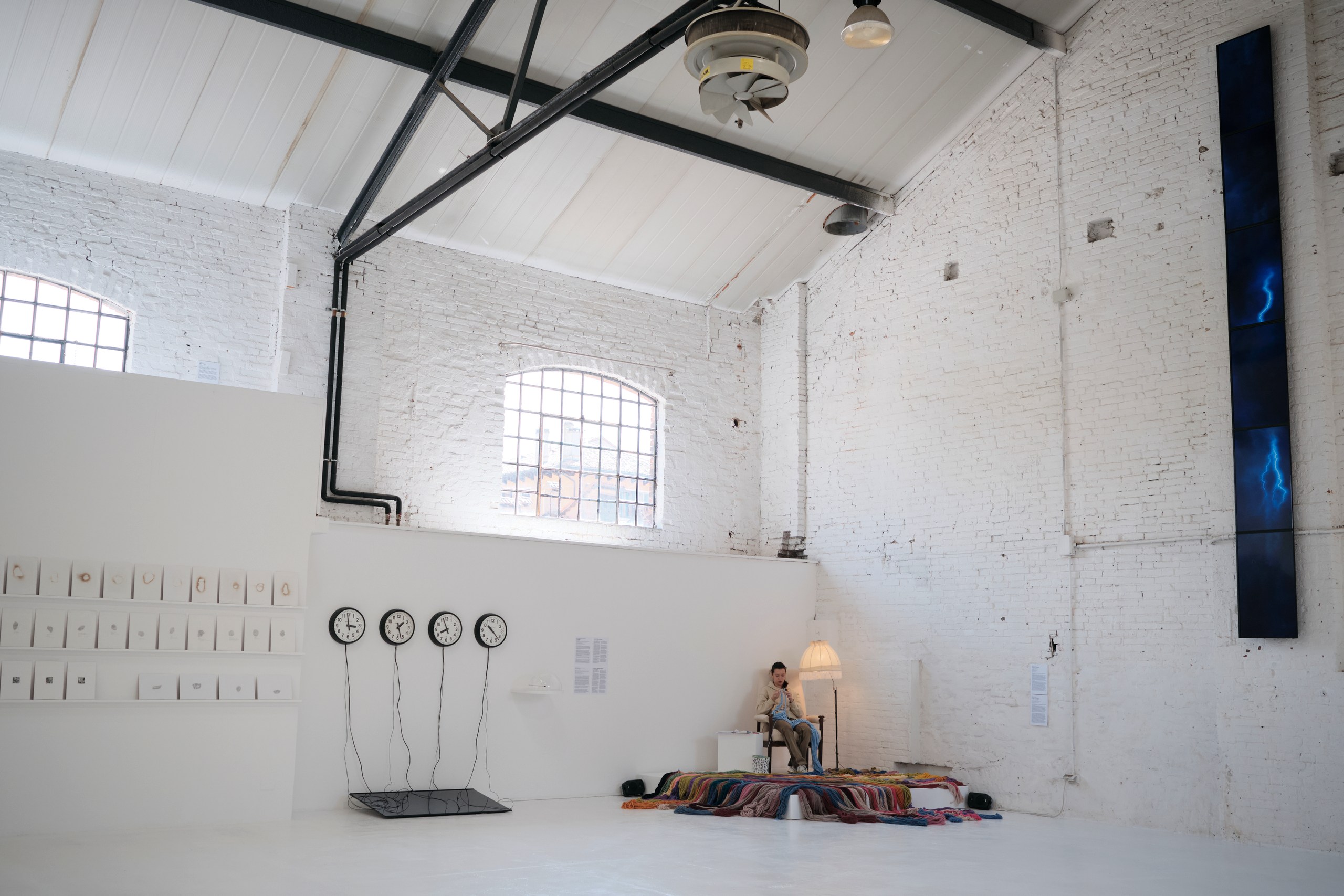
In a present marked by seemingly unstoppable acceleration, in which technology appears to have exceeded human limits and anthropocentrism is being irrevocably called into question, what is vulnerability? It is no longer an individual emotional state but a collective condition — not only human but also “more-than-human”, involving nature and ecosystems threatened by climate change. This is the theme chosen by Elena Gubanova and Silvia Burini for CYFEST, the touring media art festival founded in 2007 and now in its fifteenth edition.
The fifteenth edition of CYFEST arrives in Venice
Following earlier editions in Yerevan, Armenia, and Miami, United States, the festival stops in Venice, on the island of Giudecca, hosted by CREA Cantieri del Contemporaneo. Investigating vulnerability, understood here as an “anti-fragility” of systems that are biological as well as social and technological, the selected artists — all of international standing — present mainly multimedia works, or works whose processes involve automation, the digital or cybernetics. One thematic strand emerges clearly: the relationship between technology and nature, accompanying visitors through the exhibition space’s two floors, beginning with Tuula Närhinen’s multidisciplinary project Drop Tracer, a study of the shape of raindrops captured by the artist on a glass slide and then enlarged macroscopically.
CYFEST 15, Vulnerability, Installation View, CREA—One Contemporary Art Space, 2024. Photo Edith Bunimovich
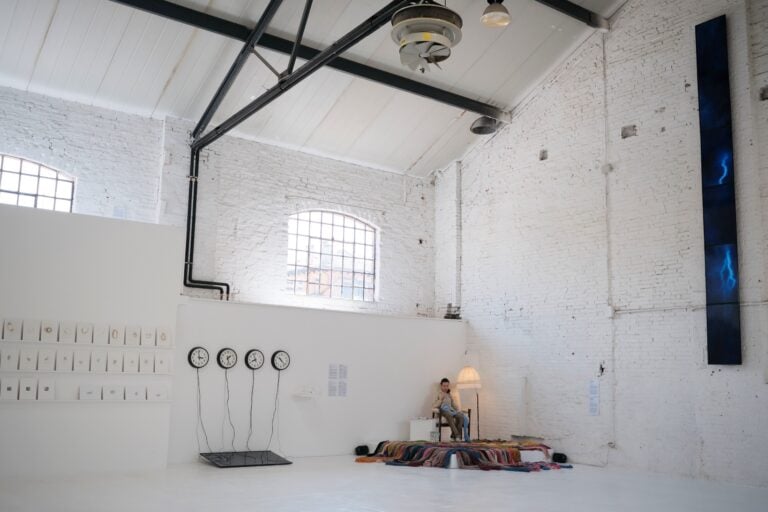
CYFEST 15, Vulnerability, Installation View, CREA—One Contemporary Art Space, 2024. Photo Edith Bunimovich
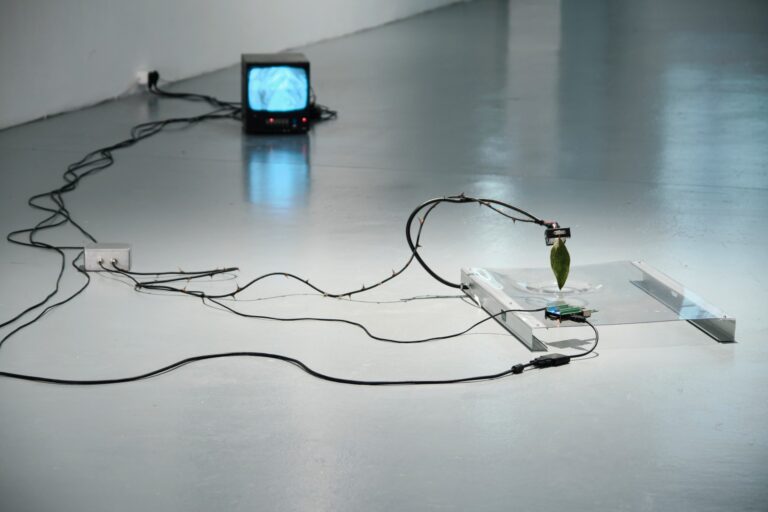
Max Blotas, Crystal clear _ Eau de Roche, Installation, 2020. CYFEST 15 Vulnerability, CREA-One Contemporary Art Space, 2024. Photo Edith Bunimovich.
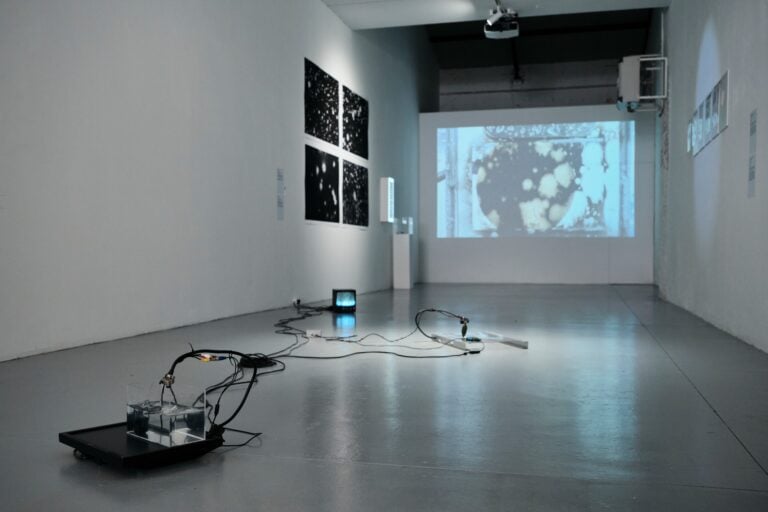
Tuula Närhinen, Drop Tracer, Sound and video installation, 2011. CYFEST 15 Vulnerability, CREA-One Contemporary Art Space, 2024. Photo Edith Bunimovich
Between technology, science art and nature
Science — or science art — is almost always present. We find it in Ann Marie Maes’s work, a kind of bacterial culture on large fabrics whose expansion prompts reflection on the importance of microbial life from a posthuman perspective. It also appears, albeit differently, in Mariateresa Sartori’s study, which offers an aesthetic investigation of geology through frottage from rocks in the Rosà quarry, in the province of Vicenza, recalling scientific cataloguing (though their character is in fact purely formal). Then there is Fabrizio Plessi’s evocative video artwork, which uses a “totem” of screens to reflect on the concept of energy, represented by lightning’s simultaneously generative and destructive power. And there is also the performative installation by the Russian collective Where Dogs Run, who “visualise” the geometry of the Mandelbrot fractal through mathematical patterns reproduced in knitted fabric.
Laura Cocciolillo
English translation of the original Italian review.