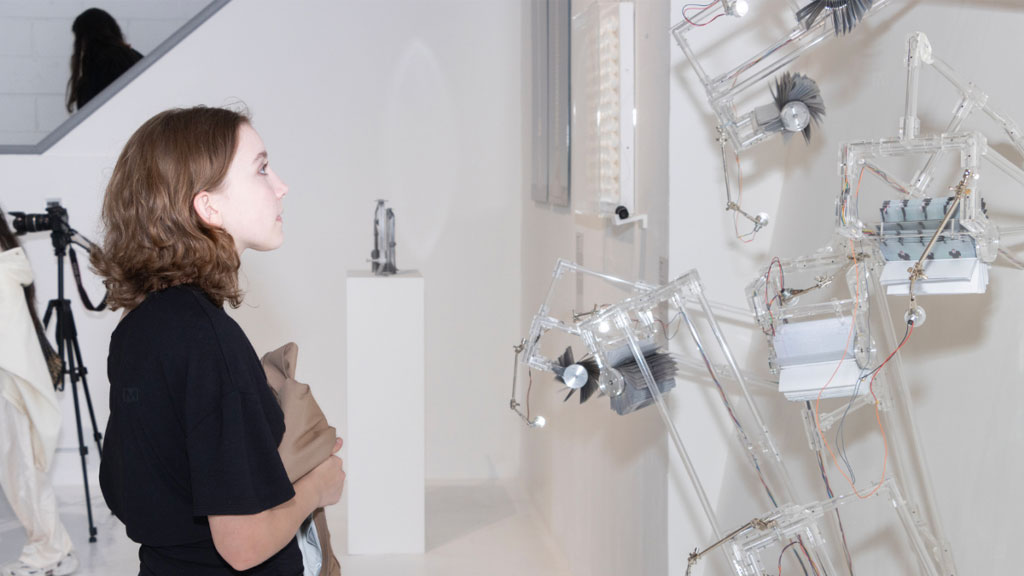
The International Media Art Festival CYFEST 17 is pleased to present Natura Naturans: Human Beings, Nature, Landscape, a new edition of one of the longest-running international festivals devoted to media art. It brings together artists, curators, engineers and activists from around the world working with time-based installations, sound, video art, algorithmic compositions and other hybrid forms in a shared reflection on the relationships between human beings, nature and landscape.
CYFEST is an itinerant media art festival now in its 17th edition, which began in Thessaloniki at the end of 2025 and will continue in Venice with a programme of performances, screenings and discussions, culminating in the temporary exhibition Natura Naturans: Human Beings, Nature, Landscape at CREA Cantieri del Contemporaneo, on display until 31 August 2026.
The exhibition’s title evokes the philosophical concept of Natura Naturans, meaning nature understood as a generative force, as process rather than product. In this context, art is conceived as an active principle: a space in which light, time and matter emerge. The exhibition brings works from the Frants Collection into dialogue with contemporary media art, tracing a continuous line of artistic creation from the twentieth century to the present. The early twentieth century marks a decisive turning point with the shift from representation to construction — from depicting the visible world to describing the forces that govern it. Colour becomes autonomous, light structural, form dynamic. The avant-garde seeks to participate in nature’s generative logic rather than attempting to imitate it.
This approach is present in the unofficial art of postwar Leningrad, where artists working outside socialist realism support an experimental approach to structure and perception, affirming art as an independent, evolving system based on process. While early modernism explores movement and time through colour and composition, contemporary artists engage with these forces through automation, kinetics, atmospheric systems and digital programming. Within this expanded ecosystem, art reveals its more sensitive sides — its pauses, hesitations and vulnerabilities — making visible the subtle threshold from which form emerges, changes and recedes. New technologies are seen not as a new layer added to the artwork, but as a sensitive space in which the work itself resides: exposed, contingent and quietly evolving.
In her automated kinetic drawings, Anna Frants explores the constantly evolving relationship between light and time, rekindling humanity’s eternal desire to capture movement through light — from prehistoric cave paintings to contemporary digital animation. Jaanika Peerna’s installation evokes the fluidity and atmospheric memory of glaciers. Its title expresses a poignant paradox: we must love glaciers deeply, but keep that love cold enough to prevent their disappearance.
Tuula Närhinen revisits avian evolution by speculating about possible hybrid bird species created to feed on plastic waste. Through this fiction of nature, the artist reflects on environmental transformation and the changing relationship between wild and urban landscapes. Mariateresa Sartori exposes an anemometer to the wind to produce circular drawings that fluctuate between mechanical objectivity and almost imperceptible human intervention.
Meanwhile, the futuristic kinetic installation by Elena Gubanova and Ivan Govorkov revisits the experimental energy of the early avant-garde, translating its dynamism into a contemporary idiom. The collective AES+F explores corporeality, depression and altered perception through digitally distilled aesthetics that oscillate between the fairy-tale and the unsettling.
Other participating artists: Andy Barrt; Aleksandr Bochkov & Matvei Peshkov; CAA (CYLAND Audio Archive); Alexandra Dementieva; Alexey Grachev; Sergey Kishchenko; Sergei Komarov & Lidiia Griaznova; Alexei Kostroma; Valery Koshlyakov; Natalia Lyakh; Linda Loh; Dmitriy Shishov; Eric Vernhes; and Mathieu Zurstrassen.
Opening performance
On 8 May, at the exhibition opening at CREA, on the island of Giudecca, Mexican artist Hugo Solis presented a live sound intervention, accompanied by a participatory performance by Jaanika Peerna. In this action, Peerna used a sculpted piece of ice as a totemic emblem of strength, beauty and environmental fragility, inviting the audience to witness and actively participate in the ephemeral balance between creation and dissolution.
Video programme — What’s in a Story?
On 9 May, the Auditorium Santa Margherita hosted the video programme What’s in a Story?, devised by curator Barbara London.
The event opened with a sculptural performance by Andy Barrt, conceived as a counterpoint to the video programme and capable of introducing the audience to a performative and visual dimension in dialogue with its themes.
Featuring Wendi Yan, Shi Zheng, Maitha Abdalla, Tamar Zohara Ettun, Tadasu Takamine, Carla Gannis, Eva Papamargariti, Jane Bustin, Andro Eradze, Sky Hopinka and Dana Kavelina, the screening brought together artists from different generations and geographical backgrounds. The selection explored the narrative potential of contemporary technologies — from the camera to software. Each artist questioned deeply held assumptions and explored the indeterminate distance between lived experience and the narrative arising from it. Their imagination united identity with agency to generate change, activating direct participation in the viewer, marked by a sense of urgency and transformation.
The evening concluded with the presentation of the volume Afterwards. Art in the Time of Change, produced by CYLAND Foundation and published by CURA. The discussion, moderated by Professor Silvia Burini, director of C.S.A.R., featured Valentino Catricalà, Barbara London and Li Zhenhua.
The discussion addressed crucial questions: what role can the artist play in shaping the future? How do artistic practices respond to technological acceleration and profound social change? Through a collection of essays and interviews, the volume offers multiple perspectives from artists, curators and experts working at the intersection of art, science and technology, encouraging reflection on how imagination and critical thinking can guide our understanding of an increasingly complex and uncertain future.
CYFEST 17 is organised by CYLAND Foundation. Its main sponsor is the Frants Foundation. This project was made possible through collaboration with Ca’ Foscari University of Venice, the Center for Studies in Russian, Central Asian and Caucasian Art — CSAR, CURA and Weave.
English translation of the original Italian announcement.